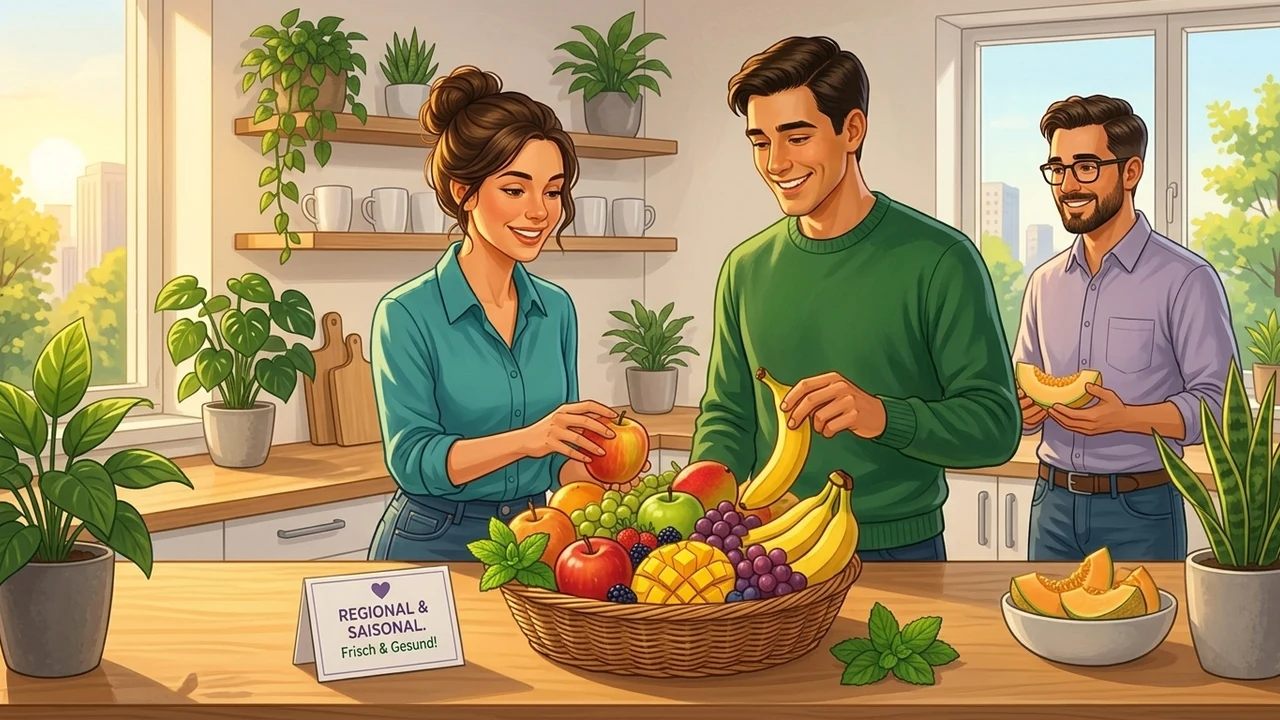
The fruit basket is the meme of workplace health promotion – and yet it has something many more elaborate measures lack: it's visible every day, available every day, and used every day. That makes it the most effective signal of an emerging BGF culture.
Why the simplest thing is often the most consistent No offering signals genuine BGF intent as effortlessly as fresh fruit that's simply there. It requires no sign-up, no changing clothes, no overcoming reluctance. Anyone who takes an apple isn't making a conscious health decision – but they're not eating a cookie either. These small shifts add up. Companies that consistently offer a well-stocked fruit basket report noticeably less consumption of sweets in the office – not because they banned anything, but because a better alternative was always within reach.
How the fruit basket becomes part of a nutrition culture A fruit basket on its own is a gesture. A fruit basket plus an occasional nutrition tip plus an info card about seasonal fruit becomes a routine. Stocking the basket seasonally and briefly explaining why it's cherries instead of bananas this week turns a convenience benefit into a small moment of education – with no extra effort and no budget.
So setzt du es um
- 1Wähle einen regionalen Lieferanten oder Wochenmarkt und lege ein wöchentliches Budget sowie eine Liefermenge pro Person fest.
- 2Plane eine abwechslungsreiche Auswahl über Äpfel und Bananen hinaus: saisonales Obst, Nüsse und Trockenfrüchte im wöchentlichen Wechsel.
- 3Bestimme einen gut sichtbaren, zentralen Standort für den Korb und bereite eine Vorlage für die wöchentliche Infokarte zu Nährstoffen vor.
- 4Stelle den ersten Korb am zentralen Standort auf und lege die passende Infokarte dazu.
- 5Informiere das Team, dass es ab jetzt wöchentlich frisches Obst, Nüsse und Trockenfrüchte gibt – kostenlos und für alle.
- 6Bitte um erste Rückmeldungen, welche Sorten besonders gut ankommen.
- 7Sorge für die wöchentliche Lieferung und wechsle die Auswahl, damit Abwechslung bleibt.
- 8Tausche jede Woche die Infokarte aus und stelle eine neue Sorte mit ihren Nährstoffen kurz vor.
- 9Achte auf Frische und Menge und passe die Bestellung an den tatsächlichen Verbrauch an.
- 10Prüfe einmal im Monat, wie viel Obst verbraucht wird und ob die Menge zum Bedarf passt.
- 11Frage im Team ab, welche Sorten Favoriten sind und was zusätzlich gewünscht wird.
- 12Passe Lieferant, Budget oder Auswahl bei Bedarf an und halte das Angebot dauerhaft attraktiv.
Was du brauchst
- Aufwand
- under 30 min
- Kosten
- under €100
- Setup
- 30 Min.
- ✓ Low cost
- ✓ High visibility
- ✓ Positive signal
Förderfähig: bis 600 € steuerfrei
Als Teil eines strukturierten BGM-Prozesses ist diese Maßnahme nach § 3 Nr. 34 EStG bis 600 € pro Mitarbeitendem und Jahr steuerfrei. Zertifizierte Angebote bezuschusst zusätzlich die Krankenkasse nach § 20b SGB V.
Im BGM-Tool umsetzen
EasyBGM verbindet diese Maßnahme mit deinen BGM-Zielen, Anlässen und KPIs — alles an einem Ort, ohne Excel.
EasyBGM kostenlos testenZahlt ein auf
Establish healthy food offeringsIncrease participation rate in BGF measures
Wirkung messen mit
Ernährungs-Puls (Kurzbefragung)
Handlungsfeld
Nutrition →Passender Anlass
- Gesunde Kantine-Challenge: "5 am Tag" Obst & Gemüse
Passende Best Practices
Nicht sicher, wo ihr anfangen sollt? BGM-Reifegrad prüfen →