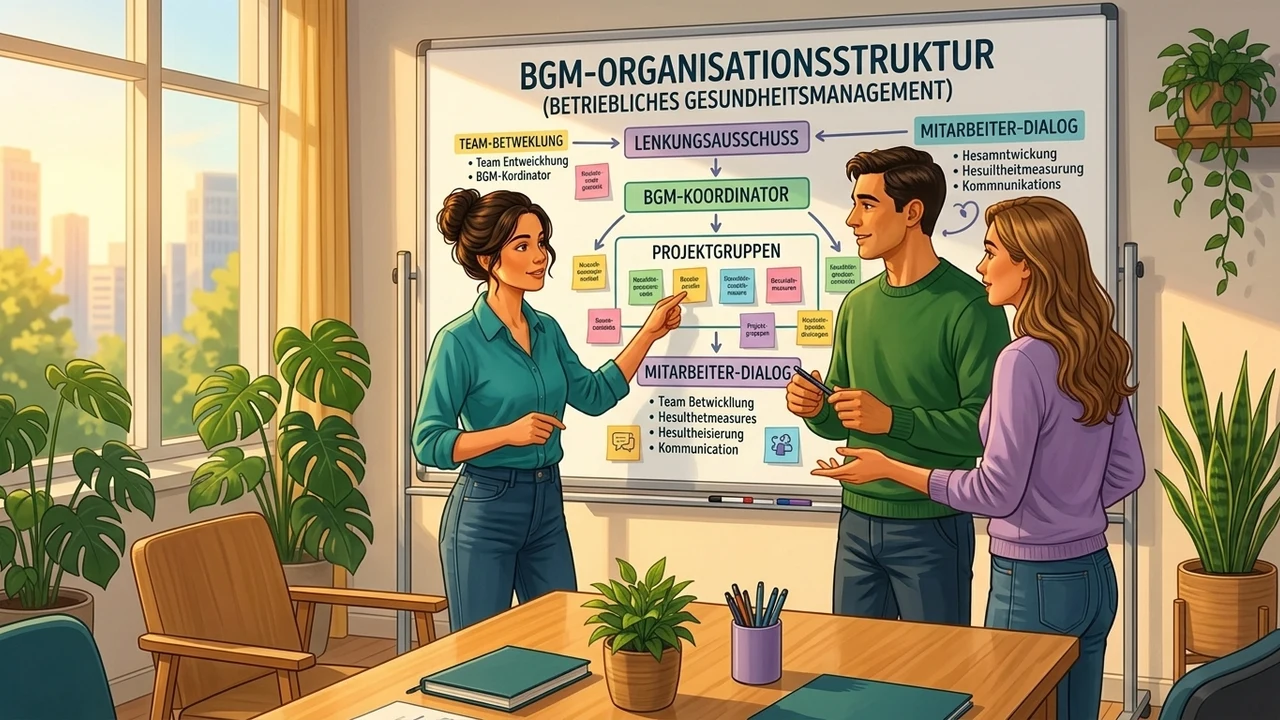
Building a BGM Structure
How do I build a BGM structure that is well organized and meets the prerequisites for a funding conversation with a German statutory health insurer (Krankenkasse)?
Under German law, a legally sound BGM per the GKV guideline requires an equally represented steering committee (Health Working Group) with a management mandate. Without this body, health insurers deny any funding under Section 20b SGB V.
Mandatory Equal Representation on the Steering Committee
| Role on the Steering Committee | Legal Basis | Task in the GKV Process |
|---|---|---|
| Management / Leadership | Section 130 OWiG (Duty of Supervision) | Grants the budget and the official project mandate — helps avoid organizational liability |
| Employee Representation (Works Council / Staff Council) | Section 87 BetrVG (Co-determination) | Secures legal acceptance, equal representation, and active employee co-determination |
| Occupational Medicine & Safety Specialist | Section 1 ASiG (Occupational Safety Act) | Links voluntary health promotion with mandatory occupational safety |
Why a Lone Fighter from HR Fails
Note: this guide refers to German law and the requirements of Germany's statutory health insurers (GKV). Anyone who launches BGM as an HR project without backing from management burns resources in the wrong places and fails, at the latest, at the health insurer's first review. The GKV Prevention Guideline does not require isolated, uncoordinated effort as a condition for granting subsidies — it requires a permanently installed steering system.
Without an official body with a clear mandate, health insurers deny any financial support and process funding under Section 20b SGB V. Checks 1 through 22 of the guideline systematically verify whether the steering committee, coordination, and management mandate actually exist — not just on paper.
In concrete terms: as soon as a BGM coordinator has to escalate every decision, as soon as the works council isn't involved, or occupational medicine is missing, funding and the tax exemption under Section 3 No. 34 EStG are at risk.
Phase 1: The Management Mandate — the Foundation for Everything
GKV Phase 1 (Checks 1–10) begins with clarifying the assignment: management issues a written mandate for a structured BGM. This document is not a formality — it is proof to the health insurer that BGM is understood as an organizational task, not a leisure-time offering.
The management mandate must include the following elements: a budget framework (even if it is only refined at the first steering committee meeting), the name of the coordination person, a clear reference to the GKV guideline as the process framework, and the frequency of steering committee meetings (minimum: quarterly).
Practical tip: many mid-sized companies underestimate how low the barrier is for this first step. A one-page document with management's signature is enough to get started. The effort takes under 30 minutes — the effect is enormous: without this document, every BGM initiative goes in circles.
Phase 2: Building the Health Working Group (Checks 11–22)
The Health Working Group (Arbeitskreis Gesundheit, AK Gesundheit) is the operational core of a GKV-compliant BGM. It is not the same as an occupational safety committee (AGS or ASA) — it complements them and has its own dedicated focus on health promotion.
Composition: management or a designated representative, HR leadership, the works council or staff council, the company physician, the occupational safety specialist, and — where available — a workplace health coordinator. At companies with fewer than 50 employees, the safety specialist role may be filled externally, which is explicitly accepted.
The Health Working Group meets at least quarterly. Minutes are mandatory — they are the only proof that the body genuinely operates on an ongoing basis. The health insurer reviews minutes as the core evidence in funding applications.
Common mistake: the Health Working Group meets once, then takes a year off, and resurfaces only to file a funding application. This gets noticed. Continuity means at least four documented meetings per year.
The Three Funding Pillars the Committee Unlocks
A functioning steering body is not just compliance — it is the key to three statutory funding mechanisms.
Pillar 1 — Section 3 No. 34 EStG: up to €600 per employee per year, tax-free, for health promotion measures. The prerequisite is embedding it in a structured BGM process — exactly what the steering committee demonstrates. Individual sports courses without a process framework do not qualify.
Pillar 2 — Section 20b SGB V: GKV funding of up to 100% of measure costs, if course concepts are certified per Chapter 7 of the GKV guideline (ZPP certification). The requirement: the company must demonstrate that the measures are embedded in an overarching BGM process.
Pillar 3 — Section 8 Para. 11 EStG: a €50 monthly tax-free benefit in kind per employee. Usable in parallel with the other two pillars. No double allowance, but additive use is possible.
Checklist: Is Your BGM Structure Ready for a GKV Audit?
- Management mandate issued in writing and archived
- Health Working Group staffed with equal representation (management, HR, works/staff council, company physician, safety specialist)
- BGM coordination person named
- At least 4 meeting dates per year planned and on the calendar
- Minutes template in place, first minutes archived
- Link to the risk assessment (Section 5 ArbSchG) established
- First health insurer contacted as a cooperation partner
Quick check
What's your company's workplace-health maturity?
Your maturity level decides whether your measures qualify for the tax-free €600 budget. Answer in 3 minutes — no sign-up.
Start maturity check (3 min.)Related measures & topics
Key takeaways
- No management mandate = no GKV funding. The document takes under 30 minutes.
- The steering committee (Health Working Group) is the only proof the health insurer really checks.
- Four meetings per year with minutes are the minimum compliance requirement.
- A functioning steering committee unlocks Section 3 No. 34 EStG, Section 20b SGB V, and the tax-free benefit in kind in parallel.
Frequently asked questions
How many employees must a company have to receive GKV funding?+
There is no statutory minimum company size. Even companies with 10 employees can apply for funding under Section 20b SGB V. For health insurer reports (anonymized health data), however, a data-protection threshold typically applies of around 20 insured members at one insurer — below that, individualized reports are not possible.
Do all the listed roles need to be on the steering committee, or is a smaller group enough?+
The GKV guideline requires equal representation in principle. In practice, many health insurers tolerate a simplified setup for very small companies (under 20 employees) — but management's involvement and an employee representative are non-negotiable. The smaller the company, the more important it is to actively involve external occupational medicine.
Can the steering committee hold meetings digitally?+
Yes, since 2020 most health insurers also accept digital meetings as proof. What matters is the minutes — they must include the date, participants, agenda, and resolutions. A Zoom screenshot without minutes does not count.
What does it cost to build a GKV-compliant BGM structure?+
The pure structure build-up (management mandate, constituting the steering committee, first meeting) involves no direct investment — only staff time. Realistically, 4–8 hours for the initial setup. Ongoing costs are limited to the quarterly meetings. The coordination role can be staffed internally — at companies with fewer than 100 employees, a 20% time allocation is enough.
Check Your BGM Maturity Level
Where does your BGM currently stand — L1 (statutory minimum) to L4 (excellence + full GKV funding)? The free check shows the next step.
Sources
- GKV Prevention Guideline 2025 — Checks 1–22: Steering Committee, Management Mandate, Coordination ↗
- Section 20b SGB V — Workplace Health Promotion ↗
- Section 3 No. 34 EStG — Tax Exemption for Workplace Health Promotion up to €600/Employee/Year ↗
- Section 87 BetrVG — Co-determination on Health Protection (No. 7) ↗
- Section 1 ASiG — Occupational Safety Act: Obligation to Provide a Company Physician and Safety Specialist ↗
Last updated: 2026-06-24. Not legal or tax advice — have your specific case reviewed by a professional.