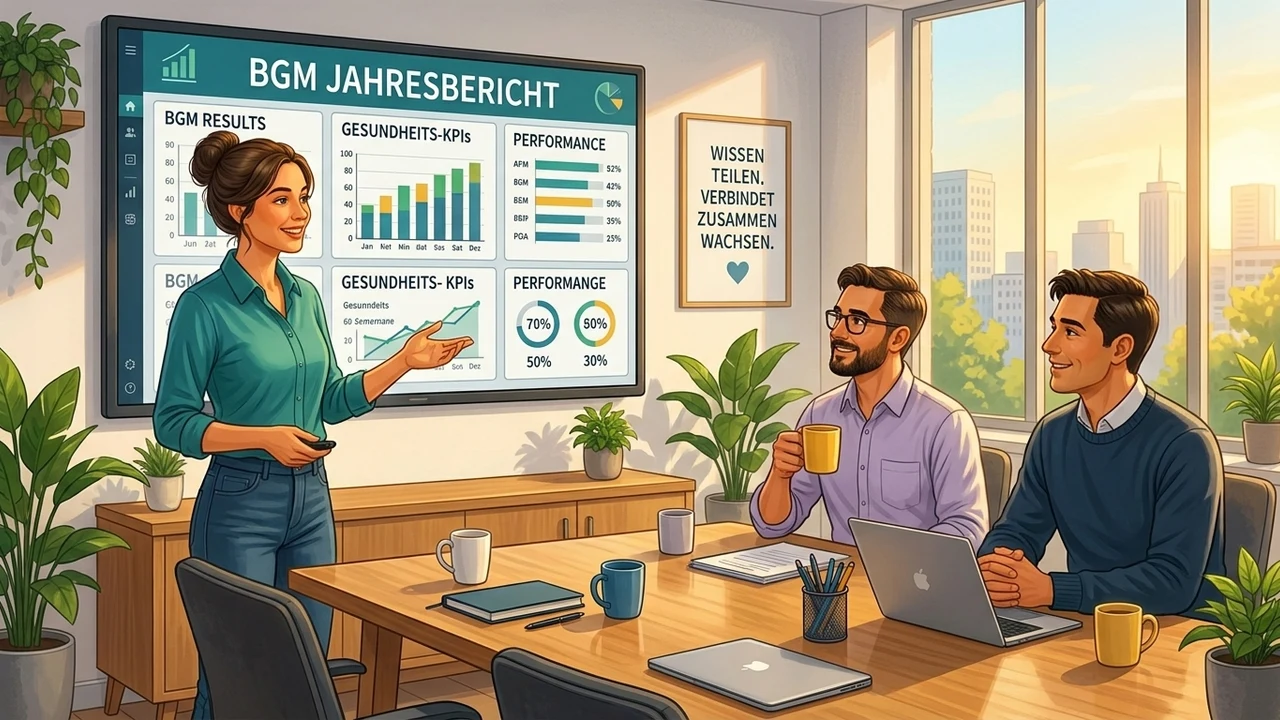
BGM Results Report
What belongs in the BGM results report for executive leadership?
Under German law, a GKV-compliant BGM results report must combine structural, process, and outcome evaluation. Participant numbers alone aren't enough — you need proof of a continuous improvement process (CIP) with measurable impact.
The three evaluation pillars of the GKV guidelines
| Evaluation Level | What Must Be Demonstrated | Typical KPIs |
|---|---|---|
| Structural evaluation | Are committees and the steering group continuously active? | Number of Health Working Group sessions, member attendance quorum, executive presence |
| Process evaluation | Did the measures actually reach the target group? | Participation rate, reduction of access barriers, reaching shift workers |
| Outcome evaluation | Improved absenteeism and subjective health? | Sick-leave rate year-over-year, health NPS, BEM rate |
The most common mistake: participant numbers instead of proof of impact
At the end of the year, executive leadership wants to know whether the money invested paid off. HR managers often make the mistake of listing only the participant numbers from sports courses and health days. These numbers say nothing about the business success of the BGM program — and regularly fail the health insurers' official audit.
What the GKV Prevention Guidelines require for phases 4 through 6 (checks 36–82): a documented continuous improvement process that proves in black and white where strain was reduced and resources were built up. That's a different narrative than 'we offered yoga and 40% took part.'
The difference literally pays off: companies with a GKV-compliant results report receive process funding under Section 20b of the German Social Code Book V (§ 20b SGB V). Without this evidence, the funding application stays on the reviewer's desk.
Pillar 1: Structural evaluation — did we hold the foundation?
Structural evaluation asks: Were the committees we set up under the executive mandate actually active? Did the Health Working Group meet as planned — with the works council, occupational health services, and executive representation?
This is measurable through minutes: number of Health Working Group sessions, average member attendance quorum (target: all mandatory members present), executive presence (mandatory member — cannot be delegated), meeting frequency (target: quarterly).
If the structural evaluation reveals gaps — e.g., the works council was absent from two of four sessions — that's a quality signal for the next year, not a reason to panic. The health insurer wants to see that the committee learns from its weaknesses.
Pillar 2: Process evaluation — did we reach the right people?
Process evaluation is the most critical of the three pillars because it honestly answers: Did our measures actually reach the people who needed them most? Or did we once again address the already-healthy 30 percent?
The GKV guidelines place special emphasis on access for groups with elevated needs: shift workers, employees without a computer workstation, older employees, people with a migration background, or those in low-skilled jobs. Anyone who can concretely show how access barriers were reduced has a strong report.
Typical process KPIs: participation rate per measure (target: no less than 20% of the target group), share of shift workers in health measures, number of low-barrier offerings (no cost, no registration, no scheduling pressure).
Pillar 3: Outcome evaluation — what did it achieve?
Outcome evaluation is what interests management the most: Did BGM measurably change anything? The KPIs here must be compared to the previous year — an absolute figure without a reference frame is worthless.
Hard outcome metrics: sick-leave rate compared to the previous year (reference: industry average per the GKV Health Report), BEM rate (share of properly initiated BEM procedures among all BEM-eligible sick-leave cases), turnover rate (where trackable).
Soft outcome metrics: subjective health from the employee survey (year-over-year comparison), manager self-assessment on health topics, Net Promoter Score for BGM offerings.
Important: Don't establish a causal link you can't substantiate. 'The sick-leave rate dropped from 6.2% to 5.8% while BGM was simultaneously intensified' is a permissible correlation statement. 'Thanks to BGM, fewer people got sick' is an impermissible causal claim without a control group.
The CIP conclusion: What do we carry into next year?
Every GKV-compliant results report ends with a chapter on the continuous improvement process (CIP). This section shows the health insurer that BGM is not treated as a one-year project but as a learning system.
Three questions structure the CIP section: (1) What worked surprisingly well? (2) What failed to reach the target group, and why? (3) What will we concretely do differently next year?
The health insurer doesn't read this section as a mere formality — it decides, based on the CIP chapter, whether the BGM program remains eligible for funding. An honest report that names weaknesses and shows learning steps is stronger than a polished success report without self-reflection.
Quick check
What's your company's workplace-health maturity?
Your maturity level decides whether your measures qualify for the tax-free €600 budget. Answer in 3 minutes — no sign-up.
Start maturity check (3 min.)Related measures & topics
Key takeaways
- Participant numbers alone aren't enough — the GKV reviews three evaluation pillars.
- Structural evaluation: Were the committees active and documented?
- Process evaluation: Were hard-to-reach groups addressed too?
- Outcome evaluation: Year-over-year comparison of sick leave and subjective health.
- The CIP chapter at the end is mandatory — honest learning steps convince the health insurer more than success announcements.
Frequently asked questions
How long should a BGM results report be?+
For an executive presentation: 8–12 pages (executive summary + three-pillar section + CIP). For the funding application with the health insurer: as specified (typically a 3–5 page summary plus an appendix with minutes). A 40-page Word report that nobody reads does more harm than good.
Does the BGM results report need to be approved by the works council?+
There's no legal requirement for works council approval. However, it's advisable to involve the works council before the executive presentation — the report contains aggregated employee data and should be backed by the employee representation. A report jointly produced by HR and the works council demonstrably has better chances with funding applications.
When during the year is the results report created?+
Ideally in Q1 of the following year, once all annual data (sick leave, completed BEM cases, survey results) is available. At the latest by the end of March. Prior-year data in systems like AOK's often isn't finalized until after a processing period — health insurers' annual reports are frequently not available until February.
Can we use the report directly for the GKV funding application?+
Yes, as a basis — but the funding application has its own structure, set by the respective health insurer. Many insurers offer an online application with predefined fields. The results report supplies all the figures entered there — it doesn't replace the application, but it is the foundation for it.
BGM progress, evaluable anytime
EasyBGM logs steering group meetings, measures, and BEM progress — and generates a results report at the push of a button.
Sources
- GKV Prevention Guidelines 2025 — Phases 4–6: Evaluation and Sustainability (§20b SGB V) ↗
- §20b SGB V — Company Health Promotion (Betriebliche Gesundheitsförderung) ↗
- §3 No. 34 EStG — Tax Exemption for BGF Benefits up to €600/Employee/Year ↗
- GKV Prevention Report 2023 — Spending and Reach of BGF (€268.9 million, 29,668 companies) ↗
Last updated: 2026-06-24. Not legal or tax advice — have your specific case reviewed by a professional.