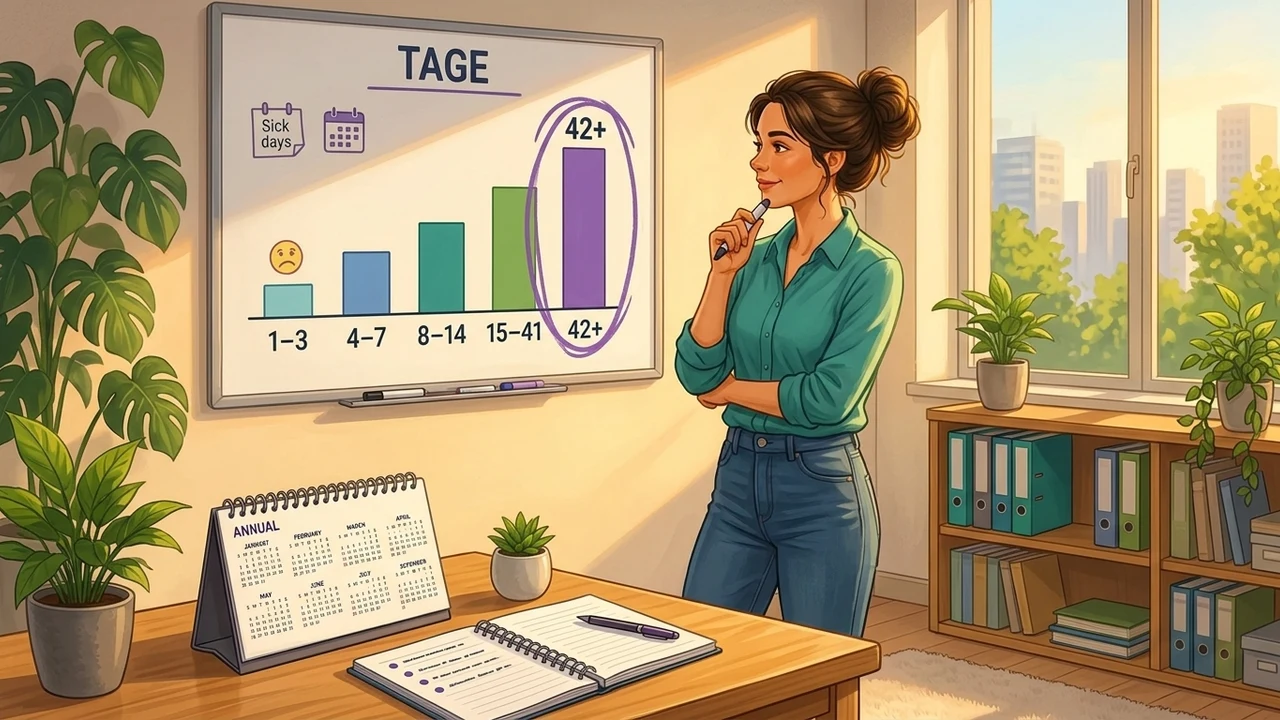
Absences by Duration Group
Short-Term or Long-Term Illness: How Do I Correctly Analyze Absences by Duration Group?
Under German law, sick-leave cases are grouped by duration: 1–3, 4–7, 8–14, 15–41, and 42+ days. Many short cases and a few long ones can produce the same sickness rate but have different causes. The 42-day mark ends continued pay and triggers the BEM duty.
The Five Duration Groups and What They Mean
| Group | Duration (Days) | Typical Pattern | Legal Threshold |
|---|---|---|---|
| Short-term | 1 – 3 | Frequent short illnesses; if recurring, an early indicator of strain or motivation issues | Sick note generally required only from day 4 (Sec. 5 EntgFG) |
| Short-Medium | 4 – 7 | Typical acute illnesses lasting up to about a week | Physician's sick note is required |
| Medium | 8 – 14 | Longer acute episodes lasting up to about two weeks | — |
| Long | 15 – 41 | Extended illness still within the continued-pay period | Still within the 6-week continued-pay period (Sec. 3 EntgFG) |
| Long-term | 42 + | Long-term illness; often chronic or mental-health conditions | Continued pay ends, sick pay begins (Sec. 44 ff. SGB V); BEM entitlement (Sec. 167 (2) SGB IX) |
Why the Sickness Rate Alone Doesn't Explain Anything
Two companies with 100 employees each and an identical 5 percent sickness rate can have completely different problems: In the first, hundreds of one- to three-day cases pile up — a pattern that can point to workload, leadership climate, or simply waves of infection. In the second, fifteen long-term cases account for almost all the lost time — here the issue is chronic illness, return-to-work management, and BEM.
The rate is the temperature reading; duration-group analysis is the diagnosis: for each sick-leave case, the duration is calculated (end date minus start date) and the case is assigned to one of five classes. Two distributions are then evaluated — number of cases per group and number of days per group. Together they form the picture: short cases almost always dominate the case count, long-term cases almost always dominate the days.
This requires individual sick-leave cases with a start and end date — a mere annual total of sick days is not sufficient for this analysis. Anyone with only totals from payroll should plan individual-case tracking as the first step in expanding their reporting.
The 42-Day Threshold: Where Business Economics and Law Meet
After six weeks of continuous incapacity to work, the employer's continued pay obligation ends (Sec. 3 EntgFG, German Continued Pay Act). From that point, the statutory health insurer pays sick pay — typically 70 percent of gross pay, capped at 90 percent of net pay (Sec. 47 SGB V). For the company's cost accounting, day 42 is a genuine turning point; for the affected employee, it means a noticeable drop in income.
At the same time, the BEM duty arises: anyone who has been unable to work for more than six weeks, whether continuously or repeatedly, within one year must be offered a Betriebliches Eingliederungsmanagement (company reintegration management) by the employer (Sec. 167 (2) SGB IX). Important: this threshold also applies to repeated short illnesses that add up over twelve months — not only to one continuous long-term case. That is exactly why determining BEM eligibility requires the same individual sick-leave case data as duration-group analysis.
For reporting purposes, it is therefore advisable always to report the '42+' group separately: it is simultaneously a cost driver, the transition to sick pay, and a BEM trigger — the one figure that matters equally to management, HR, and the works council.
Reading Short-Term Patterns — Without Putting Employees Under General Suspicion
A noticeable cluster of one- to three-day cases is a signal, not proof: it can point to overload, team conflict, or leadership problems — but just as easily to a flu wave, daycare closures, or simply seasonal effects. Serious analysis therefore always compares over time (same period, prior year) and across comparable units before drawing conclusions.
The Bradford Factor — frequency squared × total days — is a widely used tool for weighting frequent short absences more heavily than rare long ones. It works as a screening tool at the level of organizational units; as an assessment tool for individuals it is contentious and, under German employment law, should be used with caution. Recommendation: use it in aggregate as an early-warning signal, never communicate it as an individual metric.
On the intervention side, short-term patterns belong in condition-based prevention: psychosocial risk assessment, leadership-awareness training, work organization. Anyone who instead responds with attendance bonuses or pressure around returning from illness tends to shift absences into presenteeism — working while sick, whose costs the German Federal Institute for Occupational Safety and Health (BAuA) ranks as at least on par with absenteeism.
Long-Term Patterns: BEM, Return-to-Work, and the Focus on Mental Health
When groups 15–41 and 42+ dominate the lost days, the lever shifts from broad programs to case-by-case work: consistently offering BEM to everyone entitled to it, phased return to work under the Hamburg Model, and staying in touch during the illness — voluntary, caring, without pressure.
A structural driver of long case durations is mental illness: TK (Techniker Krankenkasse) reports a long-term rise in absences due to psychological disorders of 159 percent since 2006 (age-adjusted, TK Health Report 2025). Mental-health diagnoses lead to above-average case durations — anyone seeing many 42+ cases should prioritize psychosocial risk assessment and corresponding prevention programs.
Important for interpretation: a few long-term cases can statistically dominate a small workforce. A single twelve-month case corresponds to roughly one percentage point of sickness rate in a 20-person team — so never judge trends in small units on a single year.
Data Protection: Duration Groups Yes, Individual-Case Lists No
Sick-leave data is health data under Art. 9 GDPR. Duration-group analysis is permissible because — and as long as — it stays aggregated: cases and days per group, per reporting unit — never names, never diagnoses, never individual case histories in reports.
A minimum group size of five people applies: a reporting cell (e.g., 'Department X, Group 42+') is suppressed if fewer than five employees are behind it — otherwise a specific person's long-term illness becomes effectively identifiable. This is quickly the case especially with long-term cases in small departments; reporting then drops to a coarser level (site instead of department).
Identifying BEM-eligible individuals by name must be treated separately: it is permissible as a statutory duty, but belongs in an access-restricted HR process — not in KPI reports.
Related measures & topics
Key takeaways
- Same sickness rate, different diagnosis: only duration groups (1–3 / 4–7 / 8–14 / 15–41 / 42+) show what is actually driving your absences.
- Always evaluate both: cases per group (short cases dominate) and days per group (long-term cases dominate).
- Report 42+ separately: end of continued pay (Sec. 3 EntgFG), sick pay (Sec. 47 SGB V), and BEM entitlement (Sec. 167 SGB IX) all coincide.
- The BEM threshold also applies to short sick-leave periods that add up within 12 months — not only to continuous long-term cases.
- Short-term patterns → condition-based prevention and psychosocial risk assessment; long-term patterns → BEM and phased return to work.
- Mental illness drives long case durations: +159% in absences since 2006 (TK, age-adjusted).
- GDPR: only evaluate in aggregate, suppress cells under 5 people — especially for 42+ in small units.
Frequently asked questions
From when is a sick note required?+
Statutory standard: if incapacity to work lasts longer than three calendar days, a physician's certificate must be provided by the following working day at the latest (Sec. 5 EntgFG). The employer can also require it earlier. As a result, one- to three-day cases are often undercounted in the data if only certified sick-leave cases are counted — take this into account when interpreting the short-term group.
For the 42-day threshold, do calendar days or working days count?+
Sec. 167 (2) SGB IX refers to being 'unable to work for more than six weeks, continuously or repeatedly' within one year. For a single continuous case, that equals 42 calendar days. When adding up repeated short periods of incapacity, practice mostly counts days of incapacity to work; the exact counting method has not been definitively settled by the highest courts in every detail. Recommendation: count generously (when in doubt, offer BEM) — offering BEM too early is not a risk, failing to offer it is.
What is the Bradford Factor and should we use it?+
Bradford Factor = number of sick-leave episodes squared × total days. It heavily overweights frequent short absences and makes short-term patterns visible that get lost in plain day totals. Useful as an aggregated early-warning signal per organizational unit; unsuitable and legally risky as a basis for individual assessment or sanctions.
Our short-term cases are clustering in one department — what should we do?+
Validate first, then act: check the prior-year comparison and seasonal effects, and observe the minimum group size. If the pattern is confirmed, the next step is not individual-case monitoring but a psychosocial risk assessment for that area, plus a structured conversation with the manager about work organization and climate.
Are we allowed to contact employees while they are on sick leave?+
In principle yes — as a gesture of care, not control: no questions about diagnosis, no requests to work, no recovery deadlines. When done right, staying in touch is experienced by many employees as appreciative and eases their return. Standardized return-to-work conversations may be subject to works council co-determination — details and sample wording are in the BEM-Kompass guide 'Contact During Sick Leave.'
Automatically Evaluate Duration Groups
EasyBGM automatically classifies sick-leave cases into duration groups, identifies BEM-eligible cases using the 42-day logic, and maintains the minimum group size — without manual Excel work.
Sources
- Sec. 3 EntgFG — Continued Pay in the Event of Illness (6 Weeks) ↗
- Sec. 5 EntgFG — Notification and Proof Obligations (Sick Note) ↗
- Sec. 47 SGB V — Amount and Calculation of Sick Pay ↗
- Sec. 167 (2) SGB IX — Company Reintegration Management (BEM) ↗
- TK Health Report 2025 — Absences Due to Psychological Disorders +159% Since 2006 (Age-Adjusted) ↗
- BAuA — Presenteeism: Prevalence and Costs (baua: Report GD 60) ↗
Last updated: 2026-07-07. Not legal or tax advice — have your specific case reviewed by a professional.