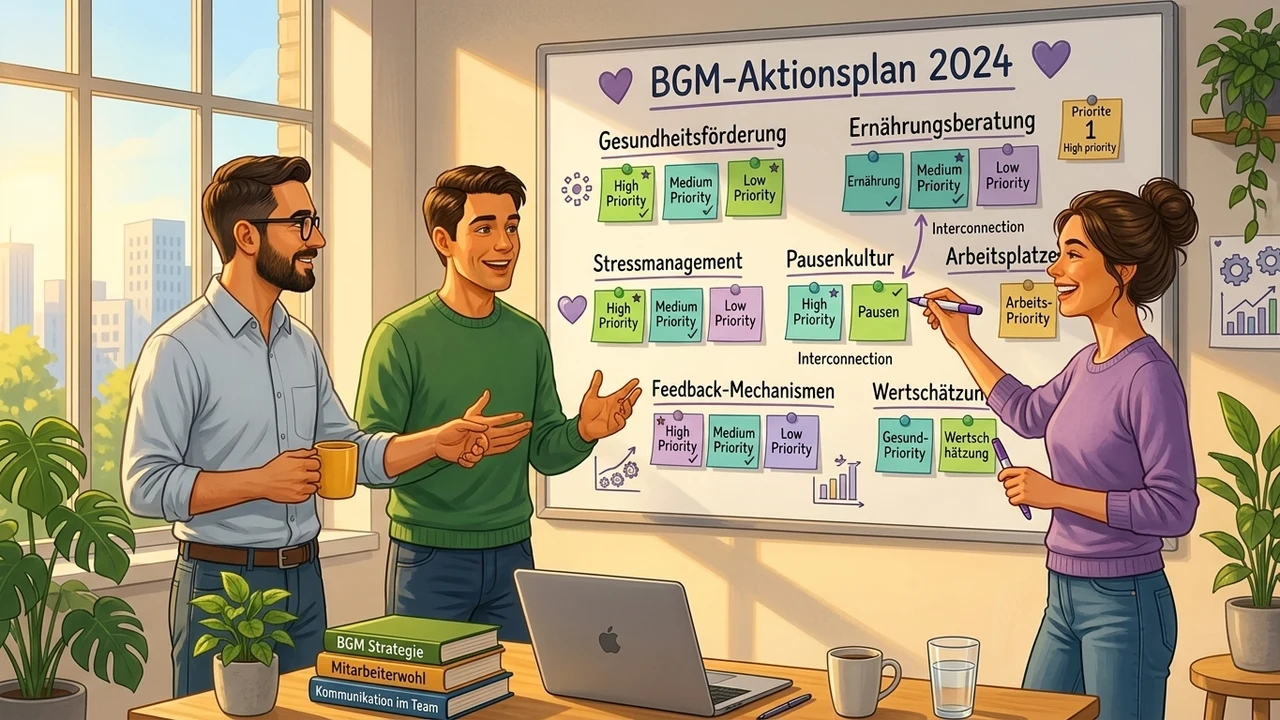
Create BGM Action Plan
How do I turn analysis results into a concrete BGM action plan?
Under German law (§ 20b SGB V), a GKV-compliant BGM action plan ranks findings by urgency × effectiveness × budget, clusters measures into GKV focus areas, and requires formal management sign-off (resolution + budget minutes) — without it, statutory health insurers deny funding.
BGM Action Plan: Structure Template per GKV Guide Phase 3
| Measure | GKV Focus Area | Target Group | Responsible | Budget (€) | Timeframe | KPI | GKV-Fundable? |
|---|---|---|---|---|---|---|---|
| Back Fitness Course (12 sessions) | Movement-Friendly Work | Office staff with back issues | HR + external provider | 1.200 | Q1 | Participation rate ≥ 70 % | Yes — § 20 SGB V course |
| Psychological Risk Assessment | Stress Management / Resources | All employees | Occupational health + Health Committee | 800 | Q1–Q2 | Completion rate 100 % of departments | Yes — § 5 ArbSchG requirement |
| Manager Workshop: Healthy Leadership | Health-Oriented Leadership | Managers (team lead and above) | External BGM coach | 2.400 | Q2 | Pre/post survey manager competency +15 % | Yes — § 20b SGB V |
| Fruit Basket + Healthy Cafeteria | Healthy Nutrition | All employees | Facility / Kitchen | 3.600/year | Year-round | Cafeteria usage rate +10 % | No — not a § 20 course |
| Digitalize BEM Process | BGM Governance | Employees after 42 sick days | HR + Health Committee | 0 (in-house) | Q1 | BEM rejection rate documented | No — mandatory task |
Why BGM Projects Stall Between Analysis and Implementation
Most BGM initiatives don't fail for lack of ideas, but because analysis data never gets translated into actionable plans. Sick-leave reports are on file, health circle minutes pile up — but no one has prioritized the findings, backed them with budget, and formally approved them.
The GKV Guide to Prevention explicitly addresses this problem in Phase 3 (Checkpoints #24–#31): without a written action plan that includes resource allocation, a timeframe, and management sign-off, statutory health insurers do not consider the BGM project eligible for funding. Insurers want to see a plan in place at the audit — not just a statement of intent.
The most common pattern: HR gathers analysis findings, builds an internal presentation, gets verbal approval from management — then simply starts with whatever fitness course is available first. No written prioritization, no resource planning, no formal resolution. That's not enough for insurer funding, nor as proof of a continuous improvement process.
The Prioritization Matrix: Which Measures Come First?
Not every analysis finding carries the same urgency. The prioritization matrix from the GKV Guide evaluates three dimensions: urgency (how acute is the problem?), effectiveness (how strong is the evidence for the measure?), and budget effort (what does implementation cost relative to the expected effect?).
High urgency + strong evidence + low effort = quick win. Start these immediately — they deliver visible results early, build workforce buy-in, and produce the first KPI data for the evaluation cycle.
High effectiveness + high effort = structural measures. Plan these in parallel, secure budget, and launch in Q2/Q3. Typical examples: leadership development, a workplace ergonomics program, digitalizing the BEM process.
Low evidence + high effort = defer for now. Checkpoint #43 of the GKV Guide explicitly requires evidence-based intervention selection — measures without proof of effectiveness put insurer funding at risk.
- Quick wins (high urgency, low effort): fruit basket, standing-desk trial, short-break reminders — start immediately, no budget needed
- Priority A (high urgency, strong evidence): psychological risk assessment, back course, BEM documentation — start in Q1
- Priority B (strong evidence, medium effort): healthy leadership, nutrition counseling, workplace sports — start in Q2
- Defer: measures without a measurable KPI or without a link to a GKV focus area
Budget and Resources: What GKV Guide Phase 3 Requires
Under German law, Checkpoint #27 of the GKV Guide requires an approved financial budget as a prerequisite for action planning — not a wish list, but a formal resolution. Under § 130 OWiG, management carries the duty of oversight and must actively approve the budget, not merely tolerate it.
Alongside the financial budget, Checkpoint #26 defines the staffing resources: who coordinates, who communicates, who documents? A BGM plan without a named point of responsibility is worthless to the insurer — and internally, a recipe for nobody being accountable.
Checkpoint #28 covers other resources: rooms, equipment, IT systems, external providers. External providers in particular must be GKV-listed or demonstrably qualified for their services to be eligible for subsidy under § 20 SGB V.
Rule of thumb for SMEs: €100–200 per employee per year is a realistic BGM budget that holds up to GKV audit requirements and funds real measures. Below that, structural measures are barely feasible — only low-threshold quick wins remain.
Getting Management Sign-Off — What the Resolution Minutes Must Contain
Checkpoint #31 of the GKV Guide is unambiguous: measures must be approved by management — documented, not just communicated. For statutory health insurers, a verbal okay is not proof. They want to see minutes at the audit.
The resolution minutes must include: the date and attendees of the Health Committee meeting, a list of approved measures mapped to their GKV focus area, the approved budget per measure, the timeframe and named responsibility, and the signature or digital confirmation of management.
Without these minutes, the BGM process is considered incomplete under the GKV Guide — and therefore ineligible for funding. The insurer can retroactively deny subsidies if no proof of resolution is presented at audit.
- Date + attendee list of the Health Committee meeting
- Approved measures mapped to their GKV focus area
- Approved budget per measure (figures, not vague wording)
- Named person responsible per measure
- Timeframe: start date and planned end
- Signature or digital confirmation from management (§ 130 OWiG proof)
Launch Quick Wins Immediately, Plan Structural Measures in Parallel
A common mistake is poor sequencing: plan everything first, then implement. The GKV Guide recommends a parallel approach — launch quick wins immediately (even without a complete plan), plan structural measures at the same time, and launch them once the planning phase wraps up.
Quick wins create visibility: employees see that BGM is actually happening — not just existing as PowerPoint slides. That boosts willingness to participate in structural measures and secures management's continued support.
Structural measures need lead time: GKV-listed providers must be selected, contracts signed, rooms booked, communication planned. Use that lead time productively — while quick wins are already running and delivering the first KPI data.
Under German law (§ 20b SGB V), funding applies to quick wins as much as structural measures, provided they map to a GKV focus area, are delivered by a qualified provider, and are documented and evaluated.
Quick check
What's your company's workplace-health maturity?
Your maturity level decides whether your measures qualify for the tax-free €600 budget. Answer in 3 minutes — no sign-up.
Start maturity check (3 min.)Related measures & topics
Key takeaways
- Under German law, no written action plan with management sign-off means no GKV funding under § 20b SGB V
- Prioritization matrix: urgency × effectiveness × budget — start quick wins immediately, plan structural measures in parallel
- Every measure needs: a GKV focus area, a responsible person, budget, timeframe, KPI
- The Health Committee's resolution minutes are the proof of funding eligibility — a verbal okay is not enough
- Evidence-based selection per Checkpoint #43: measures without proof of effectiveness put insurer funding at risk
Frequently asked questions
How many measures should a BGM action plan include?+
Quality over quantity: 3–5 well-documented measures beat 15 half-documented actions. The GKV Guide doesn't score the number of measures, but their evidence, documentation, and measurable impact. For SMEs, 2–3 quick wins plus 1–2 structural measures in the first BGM year is a good target.
Does the health insurer have to approve the action plan in advance?+
No — but the insurer reviews retroactively whether the measures were GKV-compliant. Before implementation, a short coordination call with the insurer's BGM contact (usually free of charge) is recommended to clarify funding eligibility before contracts are signed.
What happens if a planned measure fails or has to be canceled?+
Document it in the Health Committee minutes and resolve on a replacement measure. The GKV Guide evaluates the process, not just the outcome — a documented plan with transparent adjustments beats a perfect plan on paper that was never implemented.
Can external BGM consultants create the action plan?+
Yes — but the resolution must happen internally. External consultants can deliver drafts and facilitate prioritization workshops, but the formal resolution (minutes + management signature) must come from your own steering committee. Insurers do not accept externally resolved plans without internal authorization.
Can I apply for GKV funding for measures that are already underway?+
Retroactively, rarely — most insurers require an application before the measure starts. Exception: some insurers accept ongoing measures if the resolution is documented. When in doubt, check with the insurer before starting.
Create Your BGM Action Plan Directly in EasyBGM
EasyBGM guides you through every phase of the GKV Guide — including action planning, resource allocation, and management resolution documentation. All the data you need for insurer funding, at the click of a button.
Sources
- GKV Guide to Prevention 2025 (§ 20 para. 2 SGB V), Phase 3, Checkpoints #24–#31 ↗
- § 20b SGB V — Workplace Health Promotion ↗
- § 130 OWiG — Breach of Supervisory Duty (Management Liability) ↗
Last updated: 2026-06-24. Not legal or tax advice — have your specific case reviewed by a professional.