ASA: Requirements & Minutes
How often must the ASA (occupational safety committee) meet — and what has to go into the minutes?
Under German law (ASiG Sec. 11), companies with 20+ employees must hold an ASA at least quarterly. Required attendees: employer rep, works council, company doctor, safety officers, safety specialist. Minutes: date, agenda, decisions, owners, deadlines.
Required ASA Attendees per ASiG Sec. 11
| Role | Required / Optional | Note |
|---|---|---|
| Employer or designated representative | Required | Often: HR lead or management representative |
| Company doctor | Required | An external company doctor is sufficient; ensure regular presence |
| Occupational safety specialist | Required | Can be external (DGUV-certified) |
| Safety officers | Required | At least 1 representative; number depends on company size/hazard level |
| Works council (if one exists) | Required if present | 2 representatives per ASiG Sec. 11 |
| Representative for severely disabled employees | Required if present | Per SGB IX Sec. 178 (2) |
| Other managers, BGM coordinator | Optional | Useful for BGM integration |
From what point on, and how often, must the ASA meet?
Under German law, ASiG Sec. 11 requires employers with more than 20 employees to establish an Occupational Safety Committee (ASA). The threshold of 20 is counted by headcount, not full-time equivalents — part-time and marginally employed staff count too.
The ASA must convene at least once per quarter. A higher frequency is possible and common at safety-critical companies. Some collective bargaining agreements and industry rules require monthly meetings.
If a company has fewer than 20 employees, the formal ASA requirement does not apply. Even so, the DGUV recommends that smaller companies set up an informal 'safety round table' — especially where occupational safety specialists are active.
What must be on the agenda of every ASA meeting?
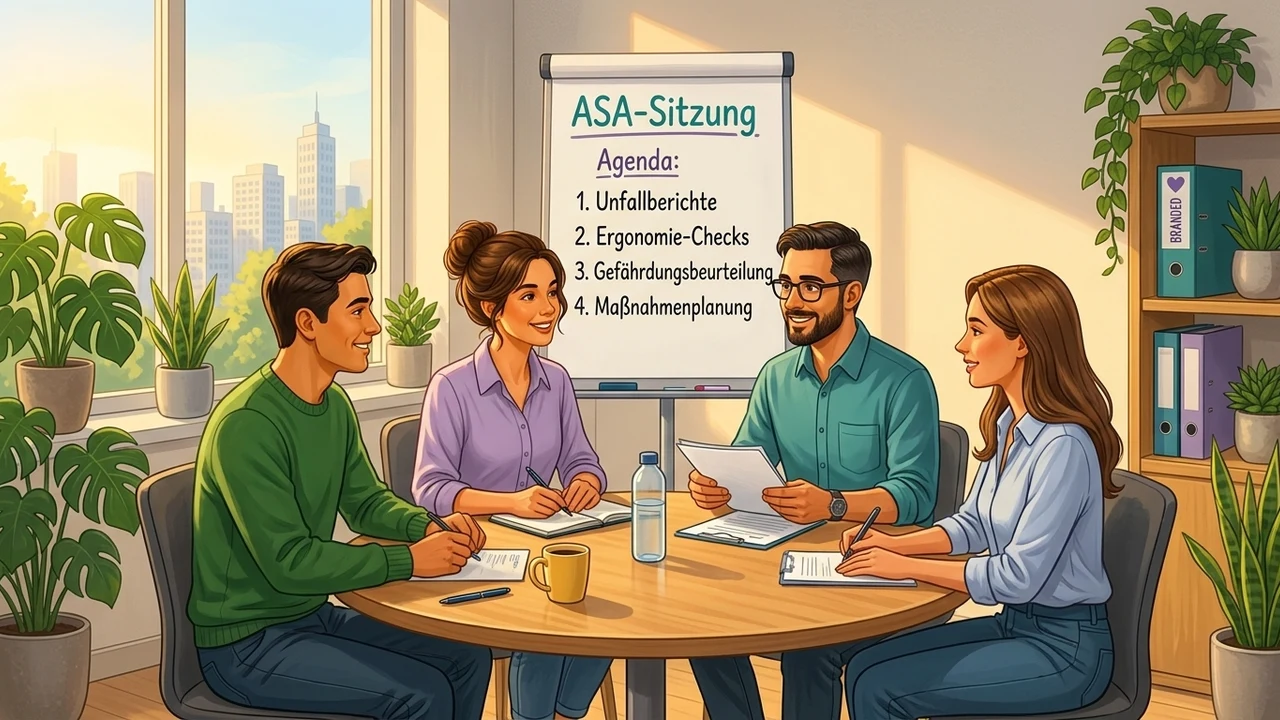
- Required agenda item: review of the previous quarter's accident statistics (accidents, near misses, suspected occupational illness cases)
- Required agenda item: results of site inspections and risk assessments — track open action items
- Required agenda item: current safety and health topics (seasonal: flu season, heat protection, darkness/visibility)
- Recommended: BGM metrics (sick leave rate, BEM case rate, program participation)
- Recommended: results of the psychological risk assessment (GBU Psyche) and progress on related measures
- Decisions with owners and deadlines — for follow-up at the next ASA meeting
Minutes requirements: What has to be recorded?
ASiG Sec. 11 requires the ASA to keep minutes. Under German law, a legally sound record includes at minimum: meeting date and location, a complete attendee list (name plus role), agenda items, the key points discussed, clearly worded decisions, the people responsible, deadlines, and follow-up on outcomes/action items from the previous minutes.
Minutes must be made accessible to all ASA members — typically by email or on the intranet. They must be retained for at least 5 years (recommendation: keep them permanently, since they can become relevant in labor court proceedings).
Digital minute-taking is permitted and more efficient. Tools like EasyBGM offer ASA minutes templates with automatic action-item tracking.
ASA and BGM — how the two come together
The ASA is the natural organizational home for BGM at mid-sized companies. Instead of setting up a separate BGM steering committee, many SMEs can simply extend the ASA: the BGM coordinator or HR lead attends regularly, and BGM topics become a standing agenda item.
Useful BGM agenda items for the ASA: sick-leave analysis by department, BEM outcomes (anonymized), ongoing programs and their participation rates, planned prevention projects, and GKV feedback on funding applications.
The advantage of this integration: the ASA already has a legally mandated communication structure and minutes requirement — so BGM documentation is produced automatically as a byproduct of meetings that are mandatory anyway.
Related measures & topics
Key takeaways
- Under German law, an ASA is required from 20 employees — quarterly minimum frequency (ASiG Sec. 11)
- Required attendees: employer representative, company doctor, occupational safety specialist, safety officers, works council
- Minutes must include decisions with owners and deadlines — retain for 5 years
- The ASA is a natural home for BGM integration — saves setting up a separate steering committee
- Digital minute-taking saves time and makes action-item tracking easier
Frequently asked questions
What happens if the ASA meets less often than quarterly?+
Germany's trade supervisory authority (Gewerbeaufsicht) can order the company to properly set up the ASA and comply with the meeting frequency. Repeated violations can trigger fines under ASiG Sec. 20 (up to €2,500 per violation). More important in practice: without ASA minutes, it's very hard to prove systematic prevention efforts after a workplace accident.
Can the company doctor be external and still fulfill ASA duties?+
Yes. An externally contracted company doctor can and should attend ASA meetings. DGUV Regulation 2 governs the required hours of engagement — for companies with up to 50 employees, often just a few hours per year. So the doctor can contribute meaningfully, meetings should be scheduled well in advance and minutes sent out beforehand.
Do small companies with fewer than 20 employees also have to set up occupational safety committees?+
No ASA requirement, but under German law the risk assessment duty (ArbSchG Sec. 5) still applies. Companies under 20 employees can still be subject to the safety-officer requirement (ASiG Sec. 22) — from 20 employees for a hazardous operation, otherwise from a higher headcount. Recommendation: still run an annual 'safety check' with the company doctor and occupational safety specialist.
Who takes the minutes — is there a legally defined responsibility?+
ASiG Sec. 11 does not name a specific person responsible for taking minutes. In practice, this is often the HR lead or the employer's representative. Important: all attendees must confirm the minutes are accurate — either by signature or by explicit approval at the start of the next meeting.
ASA Minutes, Digital and Audit-Proof
EasyBGM brings ASA templates, automatic action-item tracking, and BGM metrics together in one tool.
Sources
- ASiG Sec. 11 — Occupational Safety Committee ↗
- DGUV: Occupational Safety Committee (ASA) — Tasks and Duties ↗
Last updated: 2026-06-24. Not legal or tax advice — have your specific case reviewed by a professional.