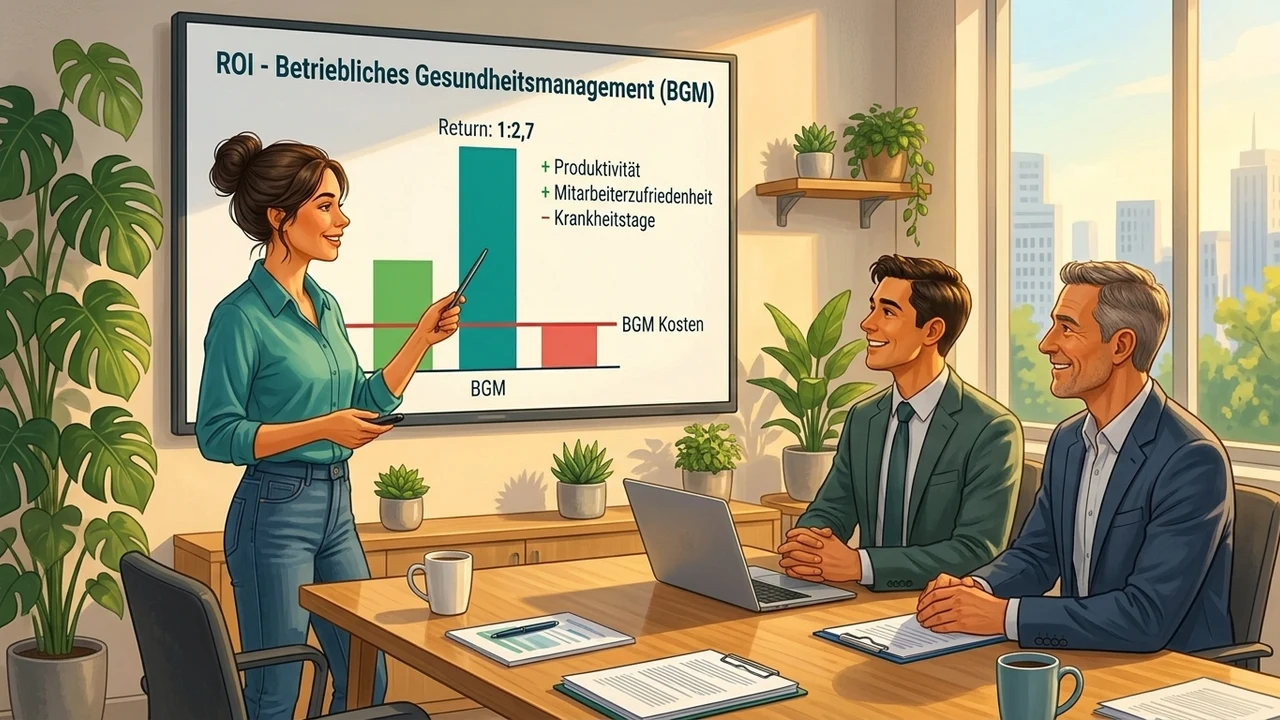
IGA Report: BGF ROI
Does BGF really pay off? What IGA Report 40 shows about the ROI of workplace health promotion
IGA Report 40 analyzes 47 ROI figures from international BGF studies: median ROI 1:2.7 — every euro invested returns €2.70 in savings on average. 85% of programs show a positive benefit. Implementation quality is decisive.
IGA Report 40: BGF ROI and effectiveness
| Metric | Value per IGA Report 40 | Note |
|---|---|---|
| Median ROI of BGF measures | 1:2.7 (median of 47 ROI figures) | Median — not average; more robust against outliers |
| Programs with positive ROI | 85% of the analyzed studies | Confirmed: the majority of programs pay off |
| ROI range | -3.3 to +15.6 | Outliers in both directions — implementation is decisive |
| Study base | 140 studies, approx. 500,000 participants | International meta-analysis — not limited to Germany |
| EU studies specifically | Average ROI of 1.7 | Lower than the international median — mind the EU context |
| One-off health actions without structure | No measurable ROI | Only meaningful with follow-up measures |
How the IGA calculates BGF ROI — and what that means for your board report
The Initiative Gesundheit und Arbeit (iga) is a joint venture of Germany's statutory health and accident insurers. IGA Report 40 synthesizes 140 international studies with approximately 500,000 participants, making it methodologically far more robust than individual company case studies. The 47 evaluated ROI figures yield a median of 1:2.7.
What the IGA ROI includes: direct continued-wage-payment costs from reduced sick leave (absenteeism), productivity loss from employees who are present but impaired (presenteeism), and turnover costs. In IGA's calculation, presenteeism is often valued at 2–3 times the cost of absenteeism — the 'invisible' cost driver.
For your board report: take your average continued-wage-payment rate (sick days x daily rate), multiply it by a reduction factor for structured BGM, and compare that to your BGM investment. This gives BGM investments an external, data-based justification.
Note: These figures and calculations are based on the German statutory health insurance (GKV) system and German legal framework; they may not translate directly to other jurisdictions.
Which BGF measures actually work according to the IGA — and which don't
IGA Report 40 draws a clear line between evidence-based and non-evidence-based measures. Evidence-based: stress management (cognitive behavioral techniques), leadership training, movement-friendly workplace design, and addiction prevention with early detection.
Low or no evidence: standalone health days without follow-up, fruit-basket programs, one-off webinars with no structural connection. The IGA warns explicitly: 'Effectiveness depends decisively on implementation quality, not on the type of measure alone.' That also explains the wide range (-3.3 to +15.6) in the ROI figures.
Practical consequence: a poorly implemented program can land well below the median. The specific measure is secondary — needs analysis, embedding in an overall system, and impact monitoring are what matter.
- Stress management: at least 6 sessions, needs-based, with impact monitoring
- Healthy leadership: not a one-off — recurring training cycles
- Movement: infrastructure (bike racks, standing desks) often works better than courses alone
- Addiction prevention: early detection by managers is a strong lever
- No effect: isolated standalone measures without BGM integration
Calculating BGF ROI: a step-by-step guide for HR managers
Step 1 — Gather baseline data: average sick days per employee (e.g., 18 days/year), number of employees (100), daily continued-wage-payment rate (e.g., €150). Baseline cost block: 18 x 100 x €150 = €270,000/year.
Step 2 — Apply the IGA median ROI: with a median ROI of 1:2.7, every euro invested returns €2.70. BGM investment for 100 employees: roughly €15,000–25,000/year. Expected benefit at 1:2.7: €40,500–67,500/year from direct absenteeism effects alone.
Step 3 — Add presenteeism: according to BAuA GD 60, presenteeism costs exceed direct absenteeism costs. Conservatively adding 50%: total potential is significantly higher. That makes the median ROI of 1:2.7 plausible in the German context.
Step 4 — Mind the EU context: EU-specific studies show an average ROI of 1.7 — more conservative than the global median. In the German context, 1:2.7 is a reasonable benchmark; actual potential depends on implementation quality and baseline sick-leave rate.
Note: this German legal and statutory-insurance context (GKV) does not automatically apply outside Germany — consult local regulations for your jurisdiction.
Related measures & topics
Key takeaways
- Note: figures reflect the German statutory health insurance (GKV) context. IGA Report 40: median ROI for BGF = 1:2.7 — from 47 ROI figures, 140 studies, 500,000 participants
- 85% of the analyzed BGF programs show a positive benefit — the majority pay off
- ROI range of -3.3 to +15.6 — implementation quality is the decisive moderator
- Presenteeism costs exceed absenteeism costs (BAuA GD 60) — BGM must address both
- EU studies: average ROI of 1.7 — the German-specific context sits slightly below the global median
Frequently asked questions
How reliable are the IGA ROI figures?+
IGA Report 40 is a meta-analysis of 140 studies with approximately 500,000 participants — methodologically more solid than individual studies. The median of 1:2.7 from 47 ROI figures is statistically robust. However, the range of -3.3 to +15.6 shows that poorly implemented programs can have negative ROI. The median holds for well-executed programs, not for one-off actions.
Does the IGA ROI also apply to small businesses?+
Yes — the IGA data also includes studies of small and medium-sized businesses (KMU). However, ROI is more volatile at smaller companies: a single long-term sick-leave case (e.g., a mental health condition, 90 days) can significantly skew the statistics at a 20-employee company. Smaller businesses benefit especially from measures with low entry effort and high scalability — digital BGM platforms are therefore often more ROI-effective at small companies than individual consulting services.
How long does it take for BGF measures to show ROI?+
IGA Report 40 distinguishes short-term (6–12 months: employee satisfaction, engagement), medium-term (1–3 years: reduced sick leave, turnover), and long-term effects (3+ years: chronic conditions, GBPsych compliance). For your board report, short-term indicators matter most — sick-leave trends and survey results can be reported within a year.
What is the difference between absenteeism and presenteeism costs?+
Absenteeism = an employee is sick and absent. Costs: continued wage payment plus coverage. Measurable via sick days. Presenteeism = an employee is present but sick or exhausted — and delivers only 60–80% of normal productivity. Costs: harder to measure, but according to BAuA GD 60 they exceed direct absenteeism costs at the macroeconomic level. BGM reduces both — measures against presenteeism (stress management, leadership culture) often have a stronger long-term effect.
Calculate BGF ROI for your organization
EasyBGM automatically calculates your BGM ROI from sick-leave data — and delivers a board report that convinces leadership of the investment.
Sources
- IGA Report 40: Effectiveness and benefit of workplace health promotion ↗
- §20b SGB V — Workplace health promotion ↗
- §3 Nr. 34 EStG — Tax exemption for BGF benefits ↗
Last updated: 2026-06-27. Not legal or tax advice — have your specific case reviewed by a professional.