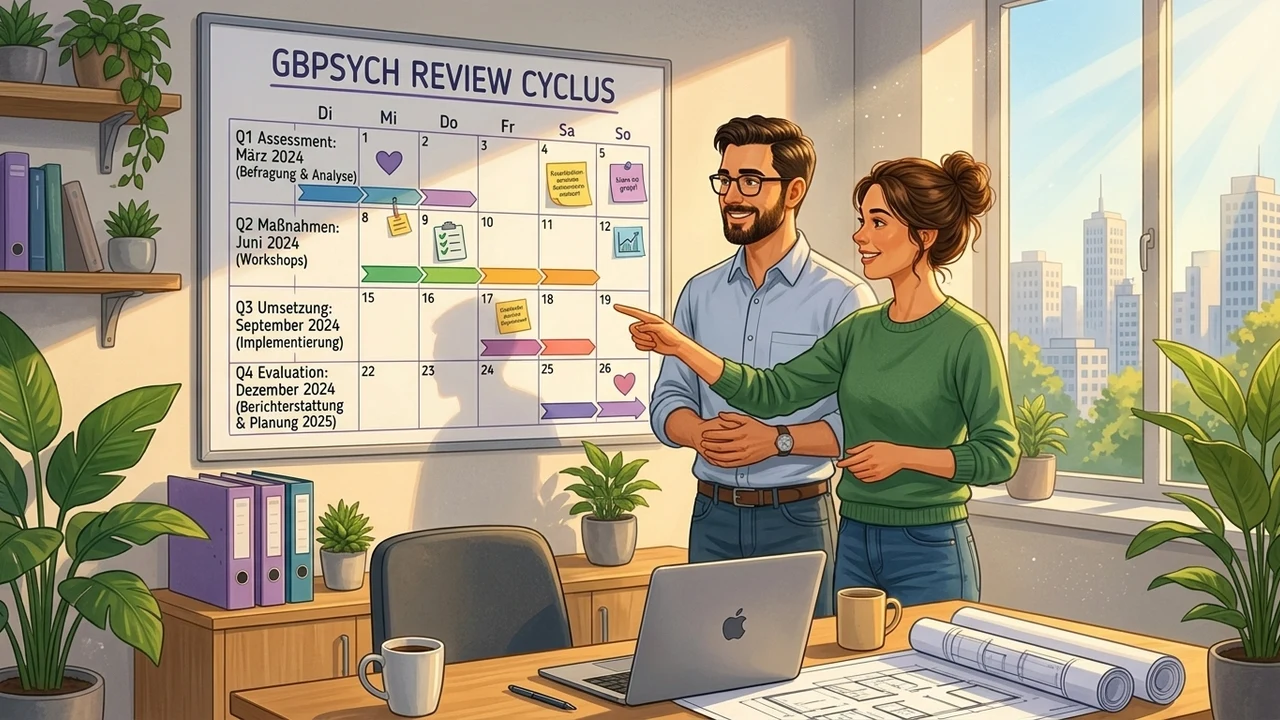
GBPsych: Repetition and Deadlines
How Often Must the GBPsych Be Repeated? Deadlines and Triggers at a Glance
Under German law, the GBPsych must be repeated after any 'significant change' to working conditions (Section 3 ArbSchG). There's no blanket deadline, but the BAuA recommends a routine review every 3–5 years, even without a specific trigger.
GBPsych Repetition: Triggers and Recommended Deadlines
| Trigger | Requirement / Recommendation | Source |
|---|---|---|
| Significant change to work organization (restructuring, new shift system) | Mandatory — new GBPsych before or shortly after the change | Section 3 ArbSchG, DGUV Guideline |
| Introduction of new technologies or work equipment (software changes, AI tools) | Mandatory — new psychological hazards must be assessed | Section 5(3) No. 6 ArbSchG |
| Noticeable increase in psychologically related absences or complaints | Mandatory — reactive repetition required (GBPsych as a diagnostic tool) | Section 9 ArbSchG, DGUV |
| Workplace accident with a psychological component, or near-miss | Mandatory — root-cause analysis including psychological hazards | Section 9 ArbSchG |
| Routine review without a specific occasion | Recommendation: every 3–5 years (BAuA Toolbox, GDA work program) | BAuA, GDA Guideline on Mental Health |
| Works council or employees request a review | Mandatory when there is a substantiated indication of new hazards (Section 12 ArbSchG) | Section 12 ArbSchG, BetrVG Section 87(1) No. 7 |
What Section 3 ArbSchG Means by 'Significant Change'
This guide covers German occupational health and safety law. The Arbeitsschutzgesetz (German Occupational Health and Safety Act, ArbSchG) sets no minimum interval for repeating the GBPsych. However, Section 3 ArbSchG requires employers to keep the risk assessment up to date and to adapt it whenever there is a 'significant change' in working conditions. The BAuA and the DGUV have clarified what counts as 'significant.'
Significant changes for GBPsych purposes include: organizational restructuring (department mergers, removal of management layers, remote-work policies), changes to working-time models (shift rotation, night work, trust-based working hours), the introduction of new technologies that fundamentally change how work is experienced (ERP system changes, AI-supported tasks, increased communication pressure from new tools), and lasting personnel changes (high turnover, new teams, new managers).
Important: Temporary exceptional situations (e.g., short-term project peaks) do not count as a significant change. A lasting intensification of work, however, does. When in doubt, repeat sooner rather than wait.
BAuA and GDA Work Program Recommendation: 3–5 Years
The German Federal Institute for Occupational Safety and Health (Bundesanstalt für Arbeitsschutz und Arbeitsmedizin, BAuA) recommends in its Toolbox Psyche a routine review of the GBPsych cycle at least every 3–5 years, even without a specific occasion. The GDA Work Program Psyche (Joint German Occupational Safety and Health Strategy, 2018–2023) has established this rhythm in practice.
A 3-year rhythm is the sensible standard for organizations with elevated psychological strain (care, hospitality, call centers, logistics). For office-based organizations with a stable work situation, a 5-year rhythm can be sufficient — provided no trigger events occur in between.
Practical note: Repeating the assessment doesn't mean starting the entire GBPsych from scratch. It can be structured as a review of existing measures (an effectiveness check under Section 3(1) ArbSchG): Which measures were implemented? Have the hazards changed? Are there new psychological strains?
GBPsych and Remote Work: What Has Changed Since 2020
The widespread shift to remote and mobile work has created a new category for the GBPsych: location-flexible work as an independent work situation that carries psychological hazards not captured in the traditional office-based GBPsych.
Psychological hazards in remote work that require a separate assessment: blurring of boundaries between work and personal life (lack of physical separation), social isolation and reduced information flow, increased communication pressure from constant availability expectations, lack of ergonomic equipment as an amplifier of psychological strain, and multiple burdens from simultaneous caregiving responsibilities.
Organizations that have not yet adapted their GBPsych for remote work since 2020 have significant catching up to do. This isn't just a formal risk — it's a real protection gap for the employees affected.
Documenting the Repetition — What Belongs in the Record
Every GBPsych repetition must be documented. The record isn't just for legal protection — it's the basis for the effectiveness check: Were the measures from the last assessment implemented? Did they work? What remains open?
Minimum content of the GBPsych record for a repeat assessment: date and reason for the repetition (significant change / routine / complaint / accident), assessed work areas and number of employees affected, identified psychological hazards (rated: none / low / medium / high), derived measures with responsible parties and implementation deadlines, and the result of the effectiveness check for measures from the last cycle.
The record must be signed by the employer or the responsible safety officer. In organizations with a works council: under Section 87(1) No. 7 BetrVG, the works council has a co-determination right regarding the conduct of the GBPsych — the record should document works council involvement.
Related measures & topics
Key takeaways
- No statutory minimum interval under German law — but a duty to repeat the GBPsych after a significant change to work
- The BAuA recommends a routine review every 3–5 years, even without a specific trigger
- Remote work and AI tools are independent triggers for a new GBPsych
- Every repetition must be documented — with reason, result, and measures
- The works council has a co-determination right regarding implementation (Section 87(1) No. 7 BetrVG)
Frequently asked questions
Is there a statutory minimum interval for repeating the GBPsych?+
No. The ArbSchG does not specify a fixed deadline. The obligation to repeat the assessment arises from 'significant changes' to working conditions (Section 3 ArbSchG) or from events such as accidents, complaints, or works council requests (Section 9 ArbSchG). The BAuA additionally recommends a routine review every 3–5 years — that's a professional recommendation, not a legal requirement.
Does introducing AI tools count as a 'significant change' for the GBPsych?+
Yes, if the AI tools fundamentally change how work is experienced — for example through decision support, increased monitorability, or evaluation of work performance through data. Section 5(3) No. 6 ArbSchG explicitly names 'inadequate qualification and instruction' as a psychological hazard, which is always relevant during the introduction phase of new technologies. For substantial changes to how work is experienced: a new GBPsych is required.
Can a repeat GBPsych be shorter than the initial assessment?+
Yes, if working conditions haven't changed significantly in certain areas. The repetition can be structured as an effectiveness check plus update: review existing hazard categories, add new ones, update measures. A complete re-survey is only necessary if the work situation has changed fundamentally.
Do remote and office employees need to be assessed separately?+
If remote employees have permanently and structurally different working conditions (different communication flow, different availability expectations, no direct management presence), there should be a separate job category. A blanket assessment treating 'all office roles the same' no longer works for mixed teams with a significant remote-work share.
Keep Your GBPsych Cycle Automatically on Track
EasyBGM automatically reminds you of due GBPsych repetitions, detects significant changes in your organizational structure, and keeps every record fully documented.
Sources
- ArbSchG Section 3 — Employer's Basic Obligations (Duty to Adapt) ↗
- BAuA Toolbox Psychological Strain — Recommendation on Repetition ↗
- GDA Work Program Psyche — Guideline on the 3–5 Year Rhythm ↗
- DGUV Guideline on Risk Assessment of Psychological Strain ↗
Last updated: 2026-06-27. Not legal or tax advice — have your specific case reviewed by a professional.